


Zoom
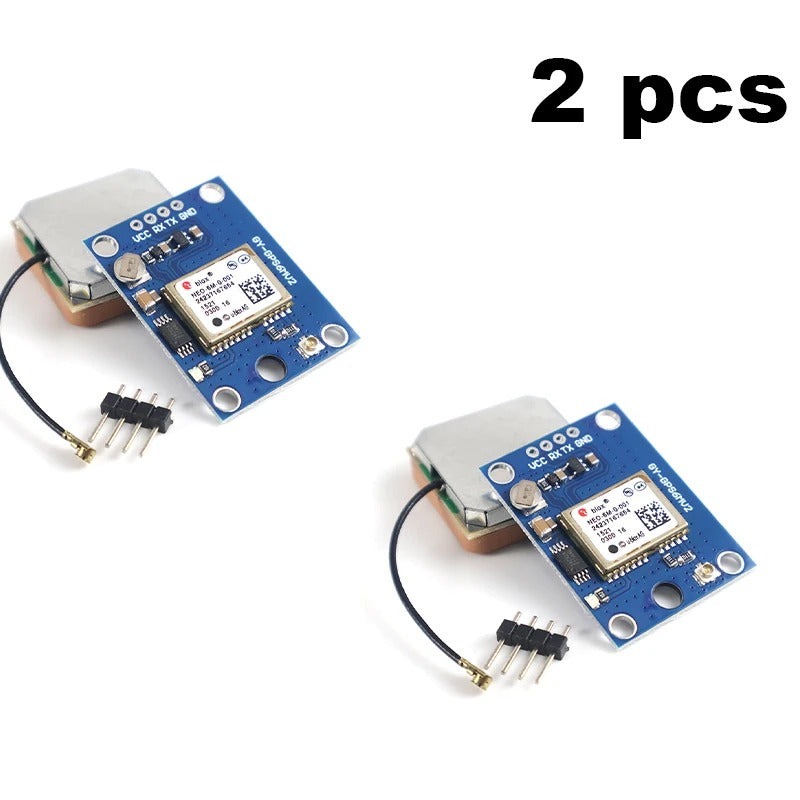

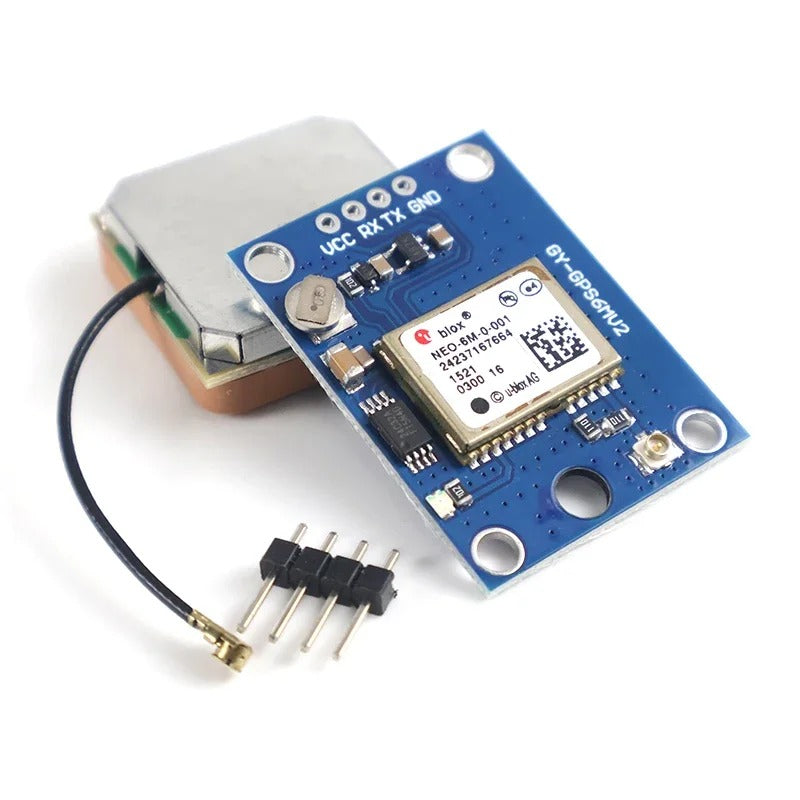
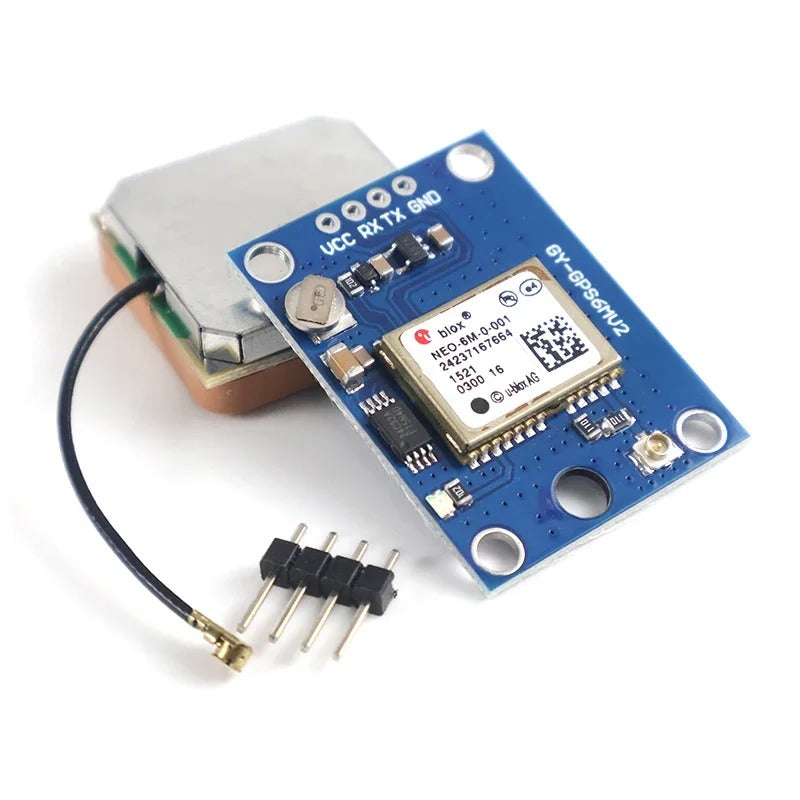

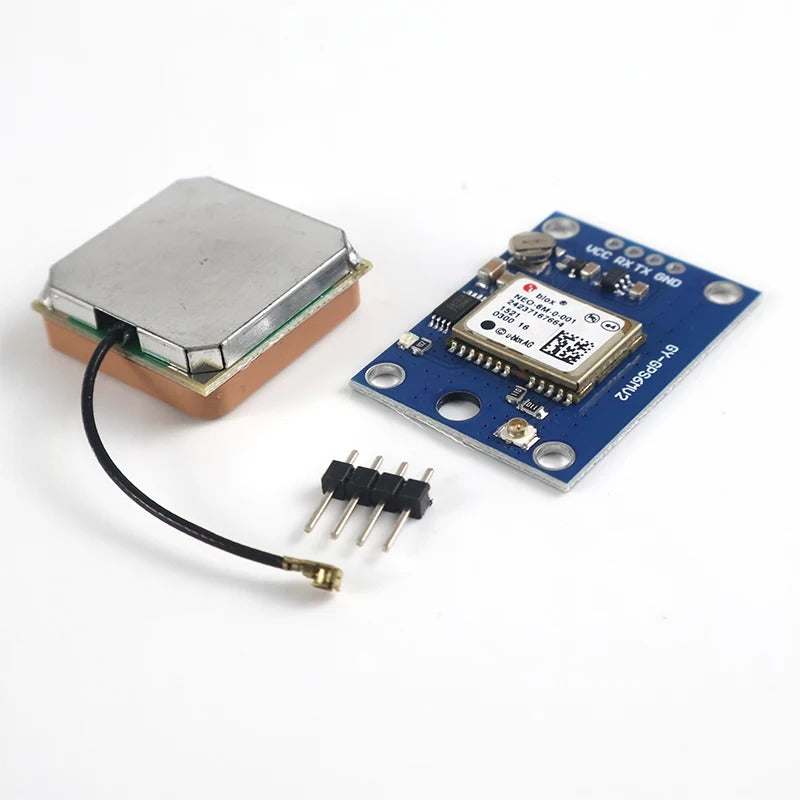
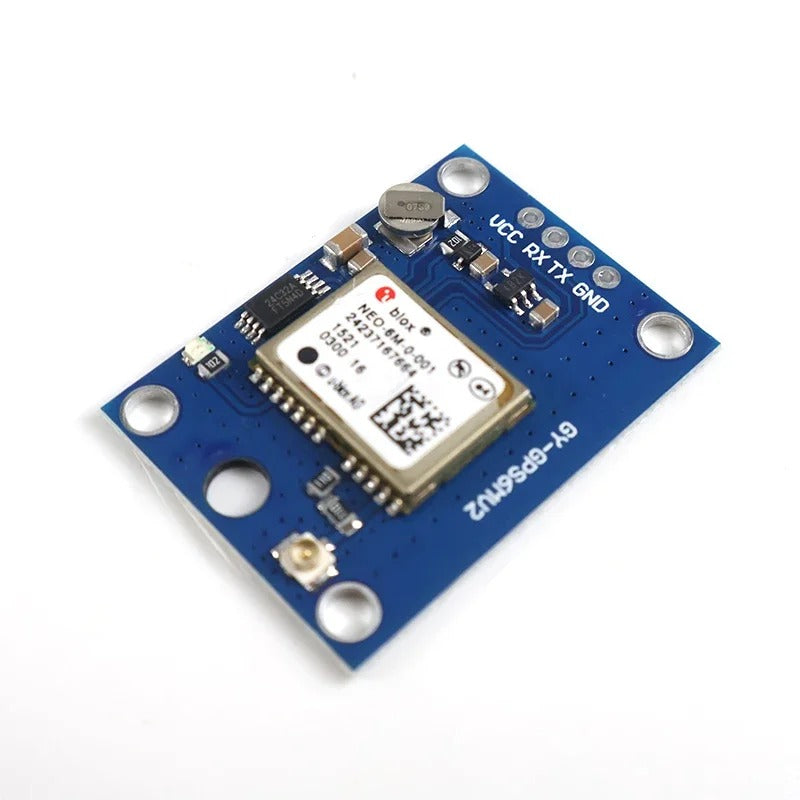

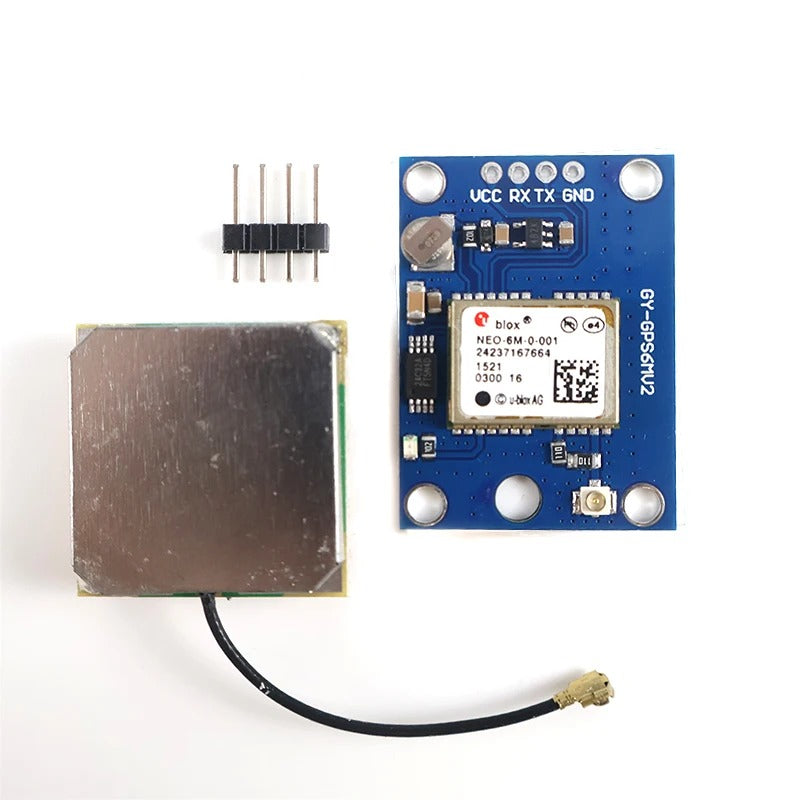
The NEO-6M GPS Module is a compact, reliable, and cost-effective satellite positioning receiver designed for electronics projects requiring real-time location, speed, altitude, and time information. Featuring the popular u-blox NEO-6M GPS receiver, a large ceramic patch antenna, onboard EEPROM, and a backup battery, this module provides a practical GPS solution for Arduino, ESP32, STM32, Raspberry Pi, robotics, UAV drones, and other embedded systems.
The module receives satellite signals from the Global Positioning System (GPS) to calculate its geographical position, including latitude, longitude, altitude, speed, and UTC time. It communicates with microcontrollers through a simple UART serial interface, typically configured to operate at 9600 baud by default.
One of the key advantages of this GPS module is its large ceramic patch antenna, which helps improve satellite signal reception when positioned correctly with a reasonably clear view of the sky. Compared with GPS receivers using smaller or less suitable antennas, a properly designed ceramic patch antenna can provide more consistent reception in outdoor environments.
The module also incorporates non-volatile EEPROM and a backup battery, which help preserve relevant configuration and satellite-related information when the main power supply is disconnected. This can reduce the time required to reacquire a GPS position after restarting the device, depending on satellite visibility and the validity of the stored data.
Whether you are building a GPS tracking system, autonomous robot, drone navigation system, vehicle monitoring device, or location-aware IoT application, the NEO-6M provides an accessible way to integrate satellite positioning into your electronics projects.
The NEO-6M receiver uses satellite signals to determine geographical coordinates and navigation information.
It can provide:
Latitude and longitude coordinates
Altitude above mean sea level
Ground speed
Direction of movement (course over ground)
UTC date and time
Satellite reception and positioning status
Under favourable open-sky conditions, the NEO-6M receiver has a typical horizontal positioning accuracy of approximately 2.5 metres, according to the receiver's published specifications.
Actual accuracy depends on satellite geometry, signal quality, environmental conditions, and antenna placement.
The module includes a ceramic GPS antenna designed to receive satellite signals transmitted at the GPS L1 frequency of 1575.42MHz.
The larger antenna surface helps provide effective signal reception when properly oriented.
Benefits include:
Improved reception under suitable outdoor conditions
Stable satellite tracking with an unobstructed sky view
Convenient integration without a separate external antenna
Suitable performance for portable GPS devices
Compact construction for embedded electronics projects
For best results, position the ceramic antenna facing upwards and away from large metal objects, high-current wiring, and sources of electrical interference.
GPS reception can be significantly reduced inside buildings, tunnels, dense forests, or between tall buildings.
The NEO-6M GPS module features onboard non-volatile memory and a backup battery circuit to support faster recovery after power interruptions.
EEPROM: Depending on the module design and configuration, EEPROM can preserve receiver settings or other supported configuration data.
Backup Battery: The battery supplies the receiver's backup domain when the main power is removed, helping retain relevant navigation information and real-time clock operation.
This can improve GPS startup performance by allowing the receiver to reuse valid information from previous operation.
The actual backup duration depends on the battery condition, circuit design, and storage conditions.
The module communicates with microcontrollers using a UART serial connection, making it straightforward to connect to Arduino, ESP32, STM32, and Raspberry Pi boards.
Most NEO-6M modules are supplied with a default communication speed of 9600 baud.
The GPS receiver typically outputs standard NMEA navigation sentences, which can be read and processed by a microcontroller.
Common NMEA sentences include:
| NMEA Sentence | Information |
|---|---|
| GGA | Position, altitude, and GPS fix information |
| RMC | Position, speed, course, date, and time |
| GSA | Satellite geometry and dilution of precision |
| GSV | Satellites in view and signal information |
| GLL | Geographic latitude and longitude |
| VTG | Course over ground and ground speed |
These messages allow developers to extract GPS coordinates and other navigation information using software libraries or custom code.
The NEO-6M module can be integrated with a wide range of microcontrollers and embedded computing platforms.
Arduino: Suitable for Arduino Uno, Nano, Mega, and compatible development boards. Libraries such as TinyGPSPlus can simplify GPS data processing.
ESP32: Can be connected through a hardware UART interface for wireless GPS trackers, web-based location monitoring, and IoT applications.
STM32: Suitable for embedded navigation, robotics, and industrial positioning systems using UART communication.
Raspberry Pi: Can provide GPS positioning information for Linux-based navigation, data logging, and tracking projects.
UAV and Drone Controllers: Can be used in compatible navigation systems that support NEO-6M GPS receivers and the appropriate communication protocol.
Compatibility depends on the controller's firmware, voltage requirements, and supported GPS interface.
The NEO-6M receiver is designed for embedded applications where power consumption and physical size are important considerations.
Its compact construction makes it suitable for installation inside:
Portable electronic equipment
Small robotic vehicles
UAV and drone systems
Battery-powered GPS trackers
Vehicle monitoring devices
Custom electronic enclosures
Power consumption varies according to the module's regulator, indicator LEDs, operating mode, and GPS receiver configuration.
| Parameter | Specification |
|---|---|
| Product Name | NEO-6M GPS Receiver Module |
| GPS Receiver IC | u-blox NEO-6M |
| Satellite System | GPS |
| GPS Frequency | L1, 1575.42MHz |
| Default Baud Rate | 9600 bps (typical module configuration) |
| Communication Interface | UART Serial |
| Output Protocol | NMEA, u-blox UBX |
| Positioning Accuracy | Approximately 2.5m CEP under suitable conditions |
| Navigation Update Rate | Up to 5Hz (receiver capability) |
| Maximum Tracking Channels | 50 |
| Antenna Type | Ceramic Patch Antenna |
| Backup System | Backup Battery |
| Non-Volatile Memory | EEPROM (module dependent) |
| Receiver Operating Voltage | 2.7–3.6V at the NEO-6M IC |
| Module Supply Voltage | Depends on onboard regulator and module version |
| Logic Interface | 3.3V-level UART; verify specific board |
| Compatible Platforms | Arduino, ESP32, STM32, Raspberry Pi |
| Applications | GPS Tracking, Robotics, UAV, IoT, Navigation |
Note: Some NEO-6M breakout boards include onboard voltage regulators allowing a higher input supply voltage. Always check the specific module's pinout and power requirements before connecting it to a 5V supply.
Many NEO-6M GPS breakout modules include four connection pins:
| Pin | Function | Description |
|---|---|---|
| VCC | Power Input | Connect to the module's specified supply voltage |
| GND | Ground | Common ground connection |
| TX | Serial Transmit | GPS data output to microcontroller RX |
| RX | Serial Receive | Receives commands from microcontroller TX |
The module normally begins transmitting GPS data after receiving power, without requiring special initialization commands.
A microcontroller can read the serial data and extract the required navigation information.
A typical Arduino connection using a software serial interface is:
| NEO-6M GPS | Arduino Uno |
|---|---|
| VCC | Appropriate regulated supply |
| GND | GND |
| TX | D4 (SoftwareSerial RX) |
| RX | D3 (SoftwareSerial TX, through suitable level shifting) |
For basic GPS data reception, the module's TX connection is sufficient; connecting the GPS RX pin is optional unless configuration commands are required.
The following example reads raw GPS data from the module and displays it in the Arduino Serial Monitor.
#include <SoftwareSerial.h>

SoftwareSerial gpsSerial(4, 3); // RX, TX

void setup() {
  Serial.begin(9600);
  gpsSerial.begin(9600);

  Serial.println("NEO-6M GPS Module Test");
}

void loop() {
  while (gpsSerial.available()) {
    Serial.write(gpsSerial.read());
  }
}
How it works:
Connect the GPS module to the Arduino.
Upload the sketch.
Open the Arduino Serial Monitor at 9600 baud.
Place the GPS antenna outdoors with a clear view of the sky.
Observe the NMEA sentences transmitted by the GPS receiver.
Once the module acquires sufficient satellite signals, valid positioning information becomes available.
For applications requiring numerical latitude, longitude, speed, or altitude values, the TinyGPSPlus library can be used to decode the received NMEA messages.
Build a GPS-based vehicle tracking system capable of recording geographical coordinates, speed, and travel routes.
When combined with an ESP32, cellular modem, or other communication module, GPS information can be transmitted to a remote monitoring server.
The NEO-6M itself receives satellite signals but does not provide cellular or internet connectivity.
The module can provide positioning information for compatible UAV flight controllers and experimental drone projects.
It can be used for position monitoring, flight data recording, and navigation functions supported by the flight controller.
Integrate GPS functionality into microcontroller projects to display location coordinates on LCD, OLED, TFT, or LED displays.
GPS information can also be stored on an SD card or transmitted wirelessly through a separate communication module.
Use GPS positioning as one component of a robotic navigation system.
GPS is particularly useful for outdoor robotics, where absolute geographical coordinates are required.
For more accurate navigation, it can be combined with sensors such as IMUs, wheel encoders, and other positioning technologies.
Create a portable GPS data logger that records latitude, longitude, altitude, speed, and timestamps at regular intervals.
The recorded data can be processed to analyse travel routes, movement patterns, or vehicle performance.
GPS satellites transmit highly accurate time information.
The NEO-6M can be used to develop GPS-synchronised clocks, timers, and timestamping systems.
Applications requiring precise hardware timing may also use the receiver's configurable time-pulse output, if exposed by the breakout board.
Develop outdoor monitoring devices that record the geographical locations of equipment, sensors, or measurement points.
GPS positioning can be combined with environmental sensors to create location-tagged measurement systems.
1. GPS requires satellite visibility.
The module performs best outdoors with a clear view of the sky. Indoor operation may be unreliable or unavailable.
2. First GPS fix may take time.
A cold start can take approximately 27 seconds under favourable conditions, based on receiver specifications. Actual acquisition time may be considerably longer depending on satellite reception and stored navigation information.
3. GPS is not an internet connection.
The NEO-6M receives satellite navigation signals. It cannot independently send GPS coordinates to a smartphone, website, or cloud server.
4. GPS does not provide centimetre-level positioning.
The NEO-6M is suitable for general-purpose positioning and tracking, but applications requiring centimetre-level accuracy generally need more advanced GNSS or RTK positioning systems.
5. Check the supply voltage.
The NEO-6M IC operates at low voltage, and breakout board power requirements vary. Verify the board's regulator and serial logic voltage before wiring.
6. Backup battery performance varies.
The backup battery may require charging during operation, depending on the module design. Stored navigation information may be lost after prolonged power disconnection.
1 × NEO-6M GPS Receiver Module
1 × Large Ceramic GPS Antenna (integrated with the module)
The package contents may vary depending on the supplied board version. Microcontrollers, cables, and additional accessories are not included unless otherwise specified.
The NEO-6M GPS Module with Ceramic Antenna, EEPROM, and Backup Battery is a practical choice for students, electronics hobbyists, engineers, and developers looking to add satellite positioning functionality to their projects.
Its simple UART interface, default 9600 baud communication, widely supported NMEA protocol, and compatibility with popular development platforms make it suitable for both beginners and experienced embedded-system developers.
From Arduino GPS trackers and ESP32 location monitoring systems to robotics, UAV navigation experiments, and GPS-synchronised clocks, the NEO-6M provides a versatile foundation for building location-aware electronic devices.
SHIPPING
Our default shipping method is Registered International Post with a tracking code. Alternatively, you may opt for express shipping via DHL or FedEx.
Please note that we endeavor to ship all orders within 24 to 48 hours. The typical delivery time frame ranges between 2 to 4 weeks.
Kindly be aware that unforeseen circumstances, including customs or postal delays, may occasionally affect delivery times beyond our control.
Customers are responsible for any customs charges and should verify their country's customs policy.
RETURNS
If you are dissatisfied with the product, you may initiate a return within one month from the date of delivery. Please ensure that the product is sent back to our address in Sydney, Australia. Kindly note that all shipping charges associated with the return are the responsibility of the customer.


Wishlist is empty.